Pasture-raised. Cage-free. Organic. Free range. Conventional. Pasture-raised.
What’s in a name? What do these terms mean? Read on to find out, and to learn more about what we do here, and why.
First things first–in a bit, I will be talking about pastures and paddocks. So, just to clarify those 2 terms real quick: a pasture is a larger piece of land. “Larger” is relative. In our case, we have 15 grazeable acres, divided into 2 pastures. That’s how the property was already fenced when we bought it. So we go through each pasture with electric fence, and break each of those pastures into smaller areas for the animals to be on for a day or a week or whatever at a time. These smaller sections are called paddocks. You with me so far? The first thing I learned when I moved out to the country is that farmers have their own lingo. Just like everyone else! But just like everyone else, I had to learn the lingo so I could learn the skills needed to keep all the animals alive!
In a conventional setting, sometimes also known as CAFO–Concentrated Animal Feeding Operation–laying hens are typically housed in 8 1/2 inch 11 inch indoor cages for the duration of their most productive egg-laying season (about 2 years). Hens naturally lay about 4-7 eggs a week, depending on breed and weather, regardless of whether they are confined or free-ranged. The cages are stacked on top of one another. Eggs roll to a ramp for easy collection, to keep eggs clean, and to keep them from being eaten by the hens. Hens are often de-beaked, making it difficult for them to eat. This also prevents them from pecking at each other through the cages–which is a sign of stress.
For meat, chickens are given the same 8 1/2 inch x 11 inch space, but typically in a wide-open structure, containing thousands of chickens. The traditional breed is Cornish Cross. These chickens are fed a corn and soy-based diet (nothing wrong with that, per se), supplemented with synthetic appetite-stimulants, so that they grow very fast. They do not move around much due to their rapid weight gain, so needing a great deal of space to move around is not necessary. Also due to their rapid growth, they are prone to leg problems and heart attacks. Depending on how and what they are fed, they can reach slaughter weight in as little as 4 weeks.
In both of these conventional settings, due to the extremely close quarters these chickens are raised in, treating with medication–typically a medicated feed–is often necessary. These chickens have zero access to the outdoors. Their lighting is 100% artificial. The lack of natural vitamin D is detrimental to proper thyroid function, and therefore confined animals and health problems–as well as intensive, hands-on, conventional interventions–often go hand in hand. However, feeding and caring for animals in this type of setting is efficient and lower-cost. Plus, conventional farmers–well, all industrial farms, regardless of if they are conventional or organic–often benefit from government subsidies–from conventional chicken farms to conventional corn- and soy-growing farms. Which is why meat from the grocery store is so much cheaper than meat grown by your local farmer–because you already paid for part of that meat through the taxes you paid that are then used to subsidize industrial farms.
“Cage-free” is a USDA term. All that “cage free” means, is the chickens aren’t raised in cages. They are still raised entirely indoors. In egg-laying operations, “cage-free” can result in greater fighting and pecking behavior in chickens, since there is no cage to separate them.
“Organic” is a USDA term. In order for chicken/eggs to be labeled “organic”, an operation must provide certified organic feed for the chickens. Some organic operations have moved into former conventional operations, raised chickens in the exact same manner as a CAFO–but the chickens are fed organic feed, and can therefore be labeled “organic”. Most organic operations are also “free range” or “pastured raised” operations, however.
“Hormone-free” sounds commendable–but the use of (previously FDA-approved) hormones was banned by the FDA several years back.
“Free Range” is another USDA term, meaning the chickens have some kind of access to the outdoors. There are no space requirements, or time spent outside requirements. Most free range operations have chickens with plenty of outdoor access and room to roam. Just be wary of wording, and do your homework!
“Pasture-raised” is not a USDA term–at least not yet. Pasture-raised typically means chickens spend the vast majority of their time outside, on pasture. Since this term is not regulated or recognized, pasture-raised can mean anything from a small moveable pen that houses 20 chickens or so (could be 2 chickens, could be 6,000) to unpenned chickens with access to a chicken coop, raised behind electric fencing. Chickens might be on lush grass, or no grass at all. Chickens might be rotated daily, weekly, periodically, or not at all. There are many variables that make a chicken “pasture-raised.”
In short, if you are concerned about what you eat, and how it was raised, just do your homework on the farm listed on the packaging.
So what do we here at 7 Arrow Ranch? Everything is raised on pasture, and is rotated on a schedule that corresponds to the needs of the animal, as well as the season. Meaning, in winter, we don’t rotate our animals as much–about every 3-5 weeks for all but our meat birds. We have egg-layers. Meat chickens. Turkeys. A guard goose. Goats. And a few cattle. All rotating frequently on pasture.
Our layer flock has a moveable shelter—a converted toy hauler—to keep them dry and comfortable, that is open to their coming and going 24/7. Their current paddock is in abundant sunshine. When they need shade, they hop inside, or under, their coop. We try to rotate them at least every week, but this can be weather-dependent. Last summer, I parked their coop under some trees, and kept them there all summer. Our pasture doesn’t have much in the way of trees. 115 degrees is brutal for these natural jungle-dwellers. I’ve learned the hard way that extreme heat + no shade can equal dead chickens.
Our animals’ safety and health is obviously our number 1 priority. When we take care of them, they take care of us.
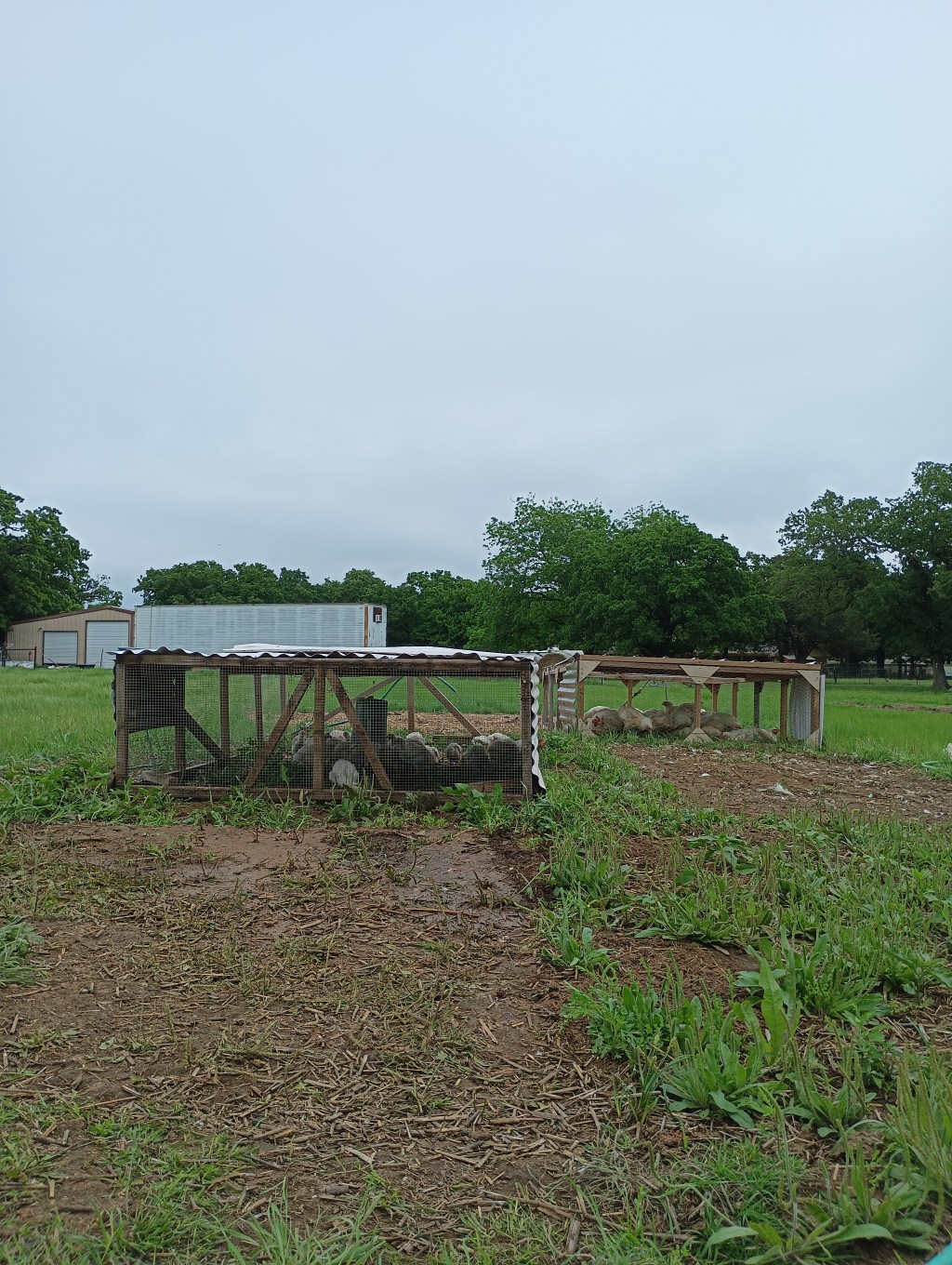
Our meat chickens are raised in moveable pens, called chicken “tractors”. We raise Cornish Cross, just like conventional farms do–there is no other breed that is as efficient as Cornish Cross in turning the feed they eat into food for us. Due to their rapid growth, we are very diligent in how and what we feed them, and how they are raised. Their pasture shelter is a wood frame wrapped in chicken wire, and half of the top is covered with white or light-colored corrugated material. The tractors have an enclosed back and partially enclosed sides when it’s cold, cool, or wet. The sides get removed once it gets hot and dry. The chickens are otherwise fully outside, getting plenty of vitamin D from the sun, which helps to regulate their growth. They get 2-3 square feet of space per chicken. Doesn’t sound like a lot, but they don’t move as much as egg-laying chickens do. They have 12-hour access to their feed–and then are cut off for 12-hours. This slows down their growth just enough to prevent most of the leg and heart problems that they are prone to. If they grow too quickly, they have a harder time getting around. We want our chickens active. Active chickens are healthy chickens. Our chickens are moved daily to a new patch of ground. So, they need to be able to move!! If there’s no grass yet, they get hay to scratch through, and sleep on. After 8-9 weeks, they are fully grown, and have an average processed weight of 4.5 lbs or so.
So, I hope this post has cleared up some of the meaning behind the labels, and gives you information on how our little farm chooses to raise our animals.
I went into the “how”, but not so much the “why”. If you are curious about the why, read this page on our website. If you want to stay up to date on the latest info and catch the latest blog posts, join our email list here. And don’t forget to like and follow us on Facebook!
Thank you and have a blessed day.
 Boots and Roots
Leave a comment