
Welcome to your first lesson on surviving a winter storm!
A brief introduction–my name is Heather Russell. I have been backpacking, camping, hiking, and generally playing in the outdoors for nearly a quarter of a century. My husband and I bought 20 acres in north Texas in 2017, and this is where we raise our 5 kids, chickens, turkeys, goats, and cattle. We’re heavily involved with American Heritage Girls and Trail Life for the boys. I’ve been teaching kids (other than my own) and adults basic outdoor skills and about God’s creation since 2010, and have been homeschooling my crew since 2011.
I have worked in 115+ degree heat, and sub-zero-degree cold. I have gotten lost on the trail, and in the “wrong” part of town. I also used to work in the “wrong” part of town. I have 5 kids, a desire to see everything I can, and a husband who travels. There have been moments–I assure you–of panic, of getting lost, and of having to figure out how to get, or be comfortable, in all kinds of environments.
We all know the weather is getting weirder and more extreme. I am a heat-loving Texan. When it drops below 80, my “inner heat” disappears. When it drops below 40, I am officially COLD. I have all the layers and appropriate gear, but I still just get–and stay–cold. So you can imagine how I felt about the winter storms the last couple of years!
I’ve lived here in the great state of Texas since I was 5 years old. For those of you outside of Texas, or who are new-ish to the state, we typically get one, maybe two days of freezing rain that shuts down all of the roadways in an area. You can usually still make it to the grocery store, though, in a pinch.
But those of you who have lived through the last 2 years of ice storms know firsthand how fragile our electric grid–as well as our food supply chain–is here. I think we’re a little bit more insulated from attacks on our grid than in other places. But we have also experienced such an influx of people moving and migrating here. We have reduced our reliance on coal, and increased our reliance on renewable energy sources. And, both our summers and our winters have broken historic records during the last 2 years. These things, and other issues, all contribute to a fragile system that, as many experienced in 2021, could crash for days.
So this winter, when your power goes out, a situation that would normally not cause a great deal of panic can suddenly induce quite a bit of fear and anxiety. Are we going to have power again soon? Or are we going to have a repeat of 2021?
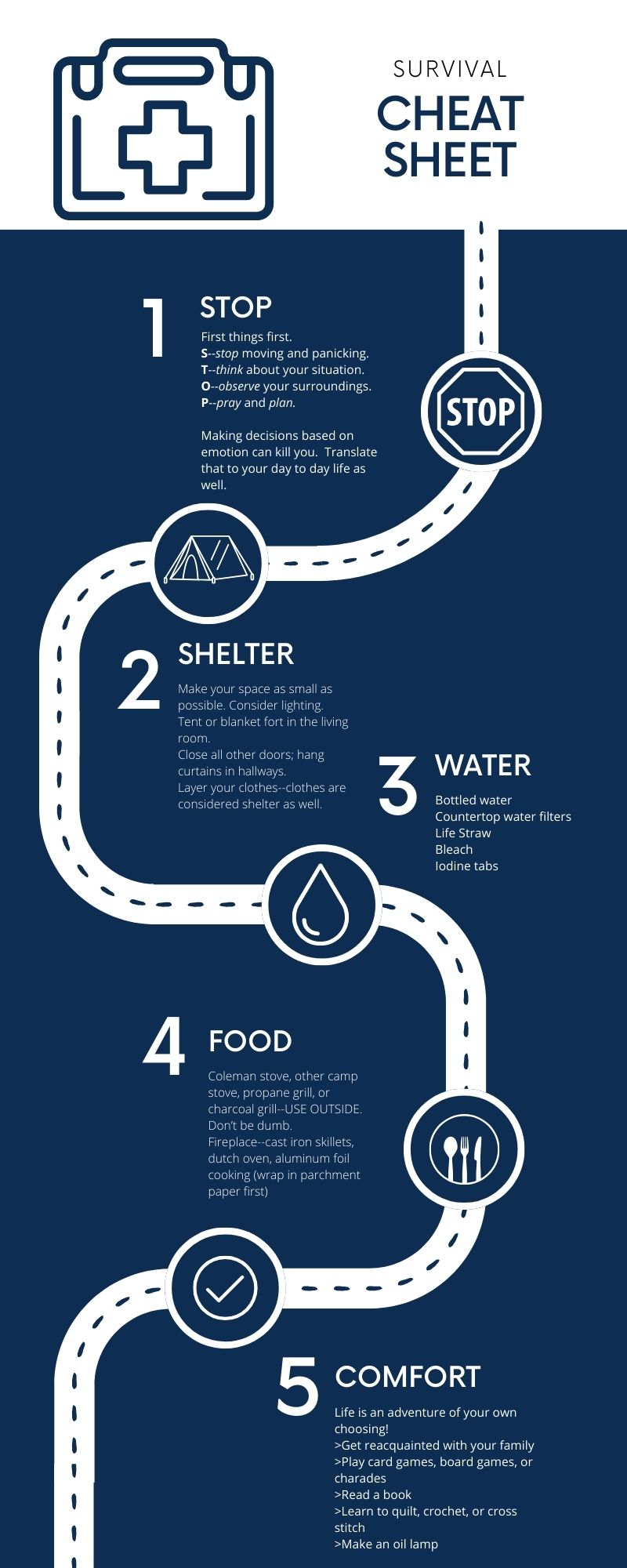
When your brain starts swirling, first and foremost, you must STOP. That stands for:
- Stop. Seriously. You alone control your thoughts and actions. Control them.
- Think. Calmly and rationally. You’re not dead, which means you’re fine. Take a deep breath.
- Observe your surroundings. Look around your home, your pantry, your closet, etc. See what you have to eat, to drink, and for warmth.
- Pray, and make a plan. Are you going to hunker down? Do you have everything you need? Is there anything you lack? If so, are you going to go without? Or are you going to leave? Is it safe? Where are you going to go? What are the road conditions like?
In order to make a well-informed, safe plan, you’ll need to consider shelter, water, and food, and you’ll need to consider those things IN THAT ORDER.
Most people think you need to consider water before shelter—but the reality is, you can suffer from hypothermia while trying to meet your water needs, if you don’t have your shelter situation figured out FIRST. Luckily, in the event of a power outage, you’re halfway to having adequate shelter!
In the following weeks, we will go more in depth into securing appropriate shelter, clean water, and food.
In our final week, we’ll talk about how to turn a cold-weather power-outage challenge into an adventure—because the NUMBER 1 factor that contributes to keeping you and your loved ones alive and well is YOUR MIND.
This is why your number 1 step in any survival situation is to STOP. Next week, we’ll start talking about shelter.
In any emergency situation, the steps are the same: STOP, consider shelter, water, and food, then just hang on, and either ride it out or get out. The skills you learn now will benefit you for any situation you find yourself in, from now on.
Now, you have some homework to do!
Between now and next week, take a good look at the infographic above. Spend just a few minutes going around your home, and make a list of the shelter, water, and food you already have or think you have, for how long (food and water–best guess), and what you think you lack. You’ll have the next several weeks to evaluate, add to your stash, or come up with creative solutions.
See you then!

 Boots and Roots
Leave a reply to Winter Storm Survival–Week 6 – Boots and Roots Cancel reply